


Hula hoop types explained: differences and how to choose
Hoop types & guidance
Hula hoops are not all one type. Dance hoops, padded fitness hoops, massage hoops, children’s hoops and specialist hoops differ considerably. Your training goal comes first when choosing, followed by height, experience, control and sensitivity to pressure.
Which types of hula hoop are available?
| Hoop type | Typical use | What to consider |
|---|---|---|
| Dance hoop / classic hoop | Basic hooping, hoop dance, transitions and tricks. | Diameter, tubing thickness, grip and weight must suit your experience and desired agility. |
| Padded fitness hoop | Controlled basic hooping and fitness-focused sessions. | Padding can make contact more comfortable; weight and diameter still need to suit the individual. |
| Massage hoop | A more intense contact sensation while hooping around the torso. | Knob shape, material, arrangement and pressure sensitivity matter more than the number of knobs alone. |
| Children’s hoop | Play, starting out and age-appropriate movement. | Not a scaled-down adult fitness hoop: size, weight, durability and handling must suit the child. |
| Arm, isolation and specialist hoop | Isolations, arm or leg hooping, performance and specialist tricks. | These hoops are selected for the movement and technique, not according to the logic of a torso fitness hoop. |
1. Define your training goal first
Someone mainly learning waist hooping needs different properties from someone planning isolations, fast hand tricks or hoop dance. “Fitness” is not a single product feature either: some people want gentle endurance exercise, others a pronounced massage sensation or a hoop for short workout intervals.
The first question is therefore not “How heavy should the hoop be?” but “Which movement do I want to perform reliably with it?”
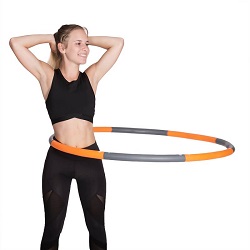
Existing image: padding and segmented construction are design features. Suitability also depends on size, weight, goal and experience.
2. Consider diameter, weight and surface together
With comparable movement, a larger diameter often rotates more slowly and can provide more time for the counter-movement while learning. This is a guideline, not a guarantee. Height, movement rhythm and experience influence how controllable a hoop feels.
Weight creates inertia and changes the contact sensation. Too much weight or an overly intense surface can become uncomfortable. With massage hoops, consider not only total weight but also how the knobs and profiles distribute pressure.
Pain or severe pressure marks are not training success. Stop the session and review the load, technique and choice of hoop.
3. Your experience matters, but not in isolation
An existing hoop provides useful information: Can you keep it moving? Does it feel comfortable, too light, too heavy or too intense? This practical experience is more informative than a rigid weight chart. It is still considered together with your goal, height, body weight and sensitivity to pressure.
Someone who already hoops confidently does not automatically need a heavier hoop. Depending on the goal, a lighter, smaller or more agile hoop may be the more useful progression.
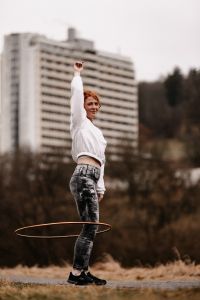
Existing image: controlled hooping depends on a suitable hoop size, sound technique and enough space to move.
Four common selection mistakes
- Choosing by body weight alone: Body weight is one factor, not a complete customer profile.
- Automatically equating beginners with “very heavy”: More inertia can help, but excessive pressure can make learning harder.
- Treating knobs as effect enhancers: They alter contact and intensity but do not prove medical or detoxifying effects.
- Expecting one specialist hoop to do everything: A good dance hoop, massage hoop and isolation hoop serve different purposes.
Which route matches your question?
| Your question | Suitable next step |
|---|---|
| I want to learn waist hooping for the first time. | Step-by-step beginners’ guide |
| I want to find specific exercises by goal and level. | Exercise hub by training goal and level |
| I want to learn dance and off-body movements. | Hooping tricks for beginners |
| I do not yet know which type of hoop suits me. | Hoopomania hula hoop buying guide |
Frequently asked questions about choosing a hula hoop
Which hula hoop is suitable for beginners?
A controllable hoop with a suitable diameter is often helpful. Whether a dance, foam or massage hoop fits also depends on the training goal, height, pressure sensitivity and previous experience.
Is a heavy hula hoop easier to learn with?
Greater inertia can make the hoop’s movement easier to feel. A very heavy or intense hoop can also be uncomfortable, so weight must never be the only criterion.
What is the difference between a dance hoop and a fitness hoop?
Dance hoops are generally more agile and designed for tricks, transitions and hoop dance. Padded fitness hoops are more often intended for controlled torso hooping and a different contact sensation.
Are massage knobs necessary for a better workout?
No. Knobs change pressure distribution and the subjective training sensation. They are neither required for effective movement nor evidence of a medical effect.
Do I need a second hoop for tricks?
Not always. Some basic movements work with your existing hoop. A lighter or differently sized specialist hoop may, however, be useful for fast off-body tricks, isolations, arm hooping or leg hooping.
Personal selection instead of a rigid chart
The Hoopomania buying guide first gathers the relevant information and then assesses it as a whole. The best solution may be a new hoop, or it may be to keep using or sensibly adapt the hoop you already own.
Professional context
- Hoopomania knowledge base: training goal, body data, experience, pressure sensitivity and existing hoop are considered together.
- Cluff et al. 2008: small biomechanical laboratory study supporting different movement strategies in hooping; not a universal technique or product recommendation.
- Hula Hoop & Studies: transparent overview of research findings and limits of the evidence.