


Losing Weight with a Hula Hoop: What Is Realistic
Many people want to lose weight with a hula hoop, change their waist measurement or simply become more active again. Hula hooping can be a useful part of that process: it increases energy expenditure while you move, challenges coordination and is relatively easy to fit into everyday life at home.
Whether and how body weight changes does not depend on the hoop alone. What matters is the longer-term interaction between energy intake, exercise, everyday activity, sleep, stress, recovery, health and personal circumstances.
Can hula hooping help you lose weight?
Weight loss is not caused by one exercise. Put simply, over time the body needs to use more energy than it takes in through food and drink. Physical activity can increase energy expenditure, but the size of that contribution varies from person to person.
Hula hooping can therefore be helpful when it complements an existing routine or makes it easier to become more active. It does not replace an overall suitable diet, everyday movement, recovery or professional support where this is needed.
How can hula hooping contribute to a weight-loss goal?
| Possible contribution | What this means in practice | What it does not mean |
|---|---|---|
| More physical activity | Hooping increases movement-related energy expenditure during a session. | There is no fixed calorie figure and no guaranteed weight loss. |
| An accessible starting point | Short sessions at home can make it easier to get started. | Not everyone will automatically maintain the routine long term. |
| Routine and motivation | Music, rhythm and visible progress in technique may help people practise regularly. | Enjoyment alone does not replace an appropriate overall energy balance. |
| Coordination and core involvement | The core, back, hips, glutes and legs work together during the movement. | This is not targeted fat loss and does not promise a six-pack. |
What does research say about hula hooping and body fat?
Research on hula hooping is limited and the available studies examine different questions. In the Lahelma study, 55 overweight adults with central obesity were randomised and 53 completed both intervention phases. Participants had to be able to hoop for at least one minute. Six weeks of training with a 1.5 kg hoop, averaging about 13 minutes per day, were compared with a walking phase designed to produce a similar energy expenditure.
During the hooping phase, waist circumference and the DEXA-measured android fat percentage decreased more than during the walking phase. In this context, “android fat percentage” refers to the abdominal and trunk region defined by the DEXA analysis. Changes in body weight were small and similar in both phases.
These findings apply to this particular participant group, hoop and training protocol. They cannot predict individual weight loss, do not show that heavier hoops are generally superior and do not prove that local fat loss can be deliberately controlled.
In the smaller McGill study, 18 women began a six-week programme with a weighted hoop and only 13 returned for follow-up measurements. Waist and hip circumference decreased, but measured isometric trunk endurance did not improve and the sum of five skinfold measurements increased. As an uncontrolled before-and-after trial, the study does not provide robust evidence of fat or weight loss.
Why calorie figures are only estimates
Calorie expenditure depends on factors such as body weight, pace, duration, range of movement, technique, breaks, fitness level and hoop model. Fitness trackers, apps and tables can only estimate these individual differences.
A high number on a display is therefore not a meaningful goal by itself. More important is a level of activity that can be controlled, repeated regularly and integrated into the rest of a person’s routine. The guide to hula hoop calorie expenditure and muscles explains these estimating limits in more detail.
Can hula hooping target belly fat?
No. A single exercise cannot reliably determine where the body will lose fat first. Hooping can increase movement and engage the core, but it does not control which area loses fat.
A change in waist measurement is not automatically the same as locally burned belly fat. Fat distribution, digestion, fluid balance, posture and other factors can all affect measurements. The specialist guide to hula hooping and abdominal muscles explains how the core works and why neither a six-pack nor local belly-fat loss can be promised.
Why a manageable start matters more than maximum intensity
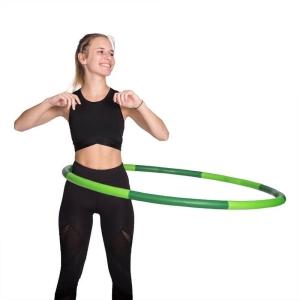
Training can only support a goal if it is actually performed and tolerated well. For beginners, short controlled sessions are often more useful than starting immediately at maximum pace or with a particularly heavy hoop.
A few minutes may be enough at first to develop rhythm and body awareness. Duration and intensity can then be increased gradually. Stop if you experience pain, dizziness, marked discomfort or increasing bruising, and check the cause before continuing.
The Hula Hoop Warm-Up offers a calm preparation before training, while learning to hula hoop covers the basic technique.
A realistic way to build your routine
The following overview is not a rigid training plan. It shows which decision is useful at each stage instead of imposing a general target for minutes or kilograms.
| Stage | Priority | Practical guidance |
|---|---|---|
| Getting started | Tolerance and technique | Begin with short sequences, allow breaks and finish while the movement is still controlled. |
| Building consistency | Regular practice | Find a realistic weekly routine that fits your schedule, recovery and other activities. |
| Progressing | Change one variable | Increase either duration, pace, movement variations or load first, rather than changing everything at once. |
| Adding variety | Overall activity | Combine hooping with walking, cycling, strength training or other suitable activities. |
How can you recognise an appropriate level of effort?
| What to observe | More likely appropriate | Reassess the load |
|---|---|---|
| Technique | You can guide the hoop repeatedly without frantic compensatory movements. | The movement becomes increasingly uncontrolled or depends on excessive momentum. |
| How it feels | Pressure and effort remain tolerable. | Pain, dizziness, marked discomfort or increasing bruising occurs. |
| Recovery | You feel sufficiently recovered before the next session. | Discomfort or pronounced tenderness persists. |
| Routine | The session fits realistically into your day. | The plan is so demanding that sessions are repeatedly missed or feel overwhelming. |
Diet and everyday habits matter too
Hula hooping is one part of physical activity, not a complete weight-loss programme. For long-term weight loss, the German Nutrition Society recommends combining dietary changes, behavioural changes and increased physical activity. Short-term diets often do not lead to lasting results.
Diet and physical activity complement each other; neither replaces the other.
Balanced meals that work in everyday life, drinks that fit your personal energy balance, suitable portion sizes and additional daily movement may all be helpful. The right approach depends on health, starting point and personal circumstances. The page on hula hooping and nutrition explores this topic in more detail; this page remains focused on the role of hooping.
How to assess progress realistically
A single number on the scale says little about the overall trend. Body weight can fluctuate in the short term, so it is more useful to consider several observations over a longer period.
| Observation | What it may show | Limitation |
|---|---|---|
| Training frequency | Whether an intention has become a genuine routine. | It does not show weight change on its own. |
| Technique and duration | Whether movement is becoming more controlled and can be sustained for longer. | It is not direct evidence of fat loss. |
| Body weight over time | It may show a longer-term trend. | Daily values fluctuate and should not be assessed in isolation. |
| Waist measurement or how clothes fit | It can provide an additional indication of change. | It does not show why or where body fat has changed. |
| Well-being and recovery | Whether the activity remains manageable and well tolerated. | It is subjective and does not replace medical assessment. |
Which hoop supports regular training?
The best hoop for a weight-loss goal is not automatically the heaviest one. A suitable hoop can be controlled, matches the user’s experience and creates a training feel that makes regular sessions possible.
Diameter, construction, weight, massage elements, experience and personal sensitivity to pressure all interact. Massage elements may make contact feel more intense, but they do not automatically increase calorie expenditure or fat loss. A heavy hoop can create more pressure and impair technique if it does not suit the person.
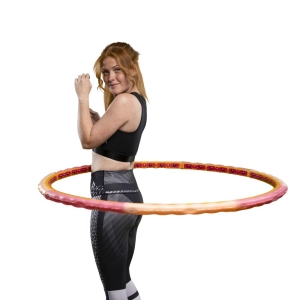
Massage elements change the contact sensation, not the basic principles of weight loss.
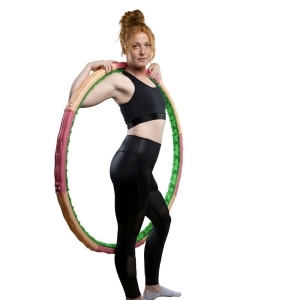
A heavier hoop is not automatically the better choice for a weight-loss goal.
The Hula Hoop Buying Guide provides personal guidance. For an overview of hoop types and uses, see Which hula hoop is right for you?
Common myths about losing weight with a hula hoop
Myth 1: The heavier the hoop, the faster you lose weight.
More weight can increase pressure and make the hoop harder to control. It guarantees neither higher energy expenditure nor better results. What matters is a suitable level of effort that can be repeated.
Myth 2: Massage bumps remove belly fat.
Massage elements mainly change the sensation of contact and pressure. They do not determine where the body loses fat.
Myth 3: A fixed number of minutes produces a fixed amount of weight loss.
Training duration is only one factor. Diet, everyday activity, intensity, breaks, body weight, health and long-term consistency all influence the outcome.
Myth 4: Bruising proves that the training is working.
Bruising and pain are not evidence of effectiveness. They are reasons to reassess the load, technique, breaks and choice of hoop.
Myth 5: Training the stomach makes fat disappear there first.
The core can work during hooping, but this does not lead to targeted local fat loss.
Train safely and realistically
Start with a duration and intensity you can control. Do not increase pace, session length and hoop weight at the same time. Stop if you experience pain, dizziness, marked discomfort or uncertainty, and check the cause.
Seek professional advice before starting a weight-loss or exercise programme if you are pregnant, have recently given birth or had surgery, or if you have a hernia, acute back or joint problems, cardiovascular disease, an eating disorder or another relevant medical condition. This page does not replace medical or nutritional advice.
Sources and context
Statements about hula hooping and body measurements draw primarily on two small studies using weighted hoops: Lahelma et al. (2019) and McGill et al. (2015). The limits of local abdominal exercise are additionally informed by Vispute et al. (2011). General statements about long-term weight management draw on the German Nutrition Society and the CDC guidance on physical activity and weight.
These sources address different questions and do not provide an individual weight-loss guarantee. In particular, they cannot justify a fixed promise for calories, weight, time or body shape, or a general product recommendation.
Frequently asked questions
The underlying Hula Hoop and contextual studies, including their limits, are reviewed on Hula Hoop & Studies.
Can hula hooping help you lose weight?
Hula hooping can support a weight-loss goal as a regular form of physical activity. The longer-term interaction between energy intake, exercise, everyday activity, sleep, recovery and personal circumstances remains decisive. The hoop alone cannot guarantee weight loss.
How many calories does hula hooping burn?
There is no single reliable figure. Body weight, pace, duration, technique, range of movement, breaks, fitness level and hoop model all affect expenditure. Tables and fitness trackers provide estimates only.
Can hula hooping specifically reduce belly fat?
No. Hooping can increase energy expenditure and engage the core, but it does not reliably determine where the body loses fat.
How long should you train for a weight-loss goal?
Begin with short, well-tolerated sequences and increase gradually. A suitable duration depends on experience, technique, effort, hoop model, other activity and recovery. There is no fixed number of minutes with a guaranteed effect.
Is it sensible to hula hoop every day?
That depends on intensity, tolerance and other physical demands. Lighter and more intensive sessions can alternate. If pain, persistent tenderness or marked bruising occurs, rest and checking the cause are more important than following a rigid daily plan.
Is a massage hula hoop better for weight loss?
No. Bumps or waves change the sensation of contact, but they guarantee neither higher calorie expenditure nor greater fat loss. Hoop selection should reflect the person’s complete profile.
Is a heavier hula hoop more effective?
Not automatically. More weight can increase pressure and make control more demanding, which may even lead to shorter or less controlled sessions. What matters is whether the hoop can be controlled, is well tolerated and can be used regularly.
How quickly can you lose weight with a hula hoop?
This cannot be predicted responsibly. The pace and extent of change depend on energy balance, starting point, everyday activity, training, health and short-term weight fluctuations. Hula hooping can increase physical activity, but it cannot guarantee a particular time frame or amount of weight loss.
Conclusion
Hula hooping can sensibly support a weight-loss goal because it can bring movement, coordination and core involvement into a manageable everyday routine. The hoop is a tool, not the sole cause of a change in body weight.
In the long term, a realistic energy balance, regular physical activity, appropriate nutrition, recovery and a hoop suited to the individual all matter. Controlled training is more valuable than maximum intensity, the heaviest possible hoop or a promise of rapid body transformation.
Your next steps:
Read more: Calories and muscles | Abdominal muscles and core | Hula hooping and nutrition