


Hoop Dance Workout: technique and choreography
Rhythm, technique and creative movement with the hula hoop - from safe waist hooping to simple dance variations.
The short answer
Hoop Dance combines hula hoop technique with music, steps, changes of direction and creative transitions. A usually lighter, easy-to-control Hoopomania Hula Hoop with the right diameter and grip is suitable for dance exercises.
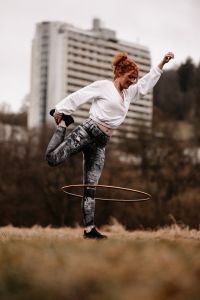
What is Hoop Dance?
Hoop dancing is free or choreographed dancing with a hoop. The hoop can be held at the waist (on-body) or moved with hands and arms (off-body). Beginners should first learn how to start the hoop, find the rhythm and maintain control before adding quick transitions or tricks.
What are these instructions based on? Hoopomania has been developing hula hoops since 2007 and provides advice on hoop selection, technique and training structure.
1. The right Hoopomania Hula Hoop for dance
A dance hoop should suit your height, experience and preferred technique. A fixed minimum size or a one-size-fits-all minimum weight is not useful.
| Goal | Guidance |
|---|---|
| Learn basic technique | A smooth-running hoop with a sufficiently large diameter. |
| Dance and transitions | Lighter, easy-to-control hoop with suitable grip. |
| Off-body and isolation | Lightweight model whose tube thickness and diameter fit securely in the hand. |
| Fitness focus | Suitable fitness hoop; usually less suitable for quick tricks. |
Important insight
The best dance hoop is not automatically the lightest or smallest hoop. It needs to be easy to control and suit your current technique.
What to look for
- Choose a diameter that suits your height and experience.
- The weight and tube thickness must remain easy to control during hand and arm movements.
- Grip should provide support without unnecessarily braking in quick transitions.
- Beginners can start with a slower, easier-to-control hoop; more experienced hoopers can choose lighter, more responsive hoops.
2. Basic technique before choreography
Safe basics make dance variations easier. The hoop moves in a circle; the core responds with short, rhythmic counter-movements.
Five steps
1. Stance: Place your feet between hip-width and shoulder-width apart; one foot may be slightly forward.
2. Position: Place the hoop horizontally on your lower back at waist level.
3. Start: Set the hoop in motion with a controlled push parallel to the ground.
4. Rhythm: Briefly move the center of your body back and forth or sideways.
5. Directions: First stabilise the easier direction, then practise the opposite direction.
First dance variations
- Move your arms to match the music.
- Add small steps forward, back and sideways.
- Vary the tempo slightly while staying in rhythm.
- Try turning slowly in the same direction as the hoop, but only while you can maintain control.
- Alternate between free movement and stable hooping.
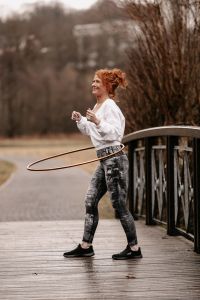
Control before speed
Do each new variation slowly at first. Only increase the speed or complexity once you can safely control the hoop, your stance and the surrounding space.
3. From basic steps to small choreography
Choreography doesn't have to be complicated. Four to six safe movements are enough for a first combination.
| Element | Example | Goal |
|---|---|---|
| Start | start the hoop horizontally and find the basic rhythm. | Control |
| Steps | Two steps sideways, back to the center. | Sense of space |
| Arms | Raise your arms, open them and bring them to the center of your body. | Expression |
| Direction | Short sequence on the opposite side. | Balance |
| Finish | Reduce the speed and stop the hoop in a controlled manner. | Safety |
How to practise effectively
- First practise each element individually without time pressure.
- Then combine two movements and repeat several times. Many movements become fluid only after several repetitions.
- Choose music with a clearly recognizable beat that is not too fast.
- Treat mistakes as part of the learning process and plan short breaks.
Separate on-body and off-body
Practice waist hooping and hand tricks separately at first. Only combine the two areas once you can start, stop and transfer the hoop safely.
4. Train safely and maintain hoops
Hoop dancing requires more space than just waist hooping. The surrounding area must be clear, especially when doing arm movements and off-body tricks.
Before training
- Keep a sufficient distance from people, animals, furniture and fragile objects.
- Train on non-slip surfaces.
- Check hoops, connectors, tape and surface.
- Choose close-fitting clothing and comfortable shoes, or make sure you have a stable barefoot stance.
Storage and transport
- Do not store hoops permanently folded or under tension.
- Protect the hoop from direct sunlight and extreme heat.
- Do not use force when folding or opening.
- After transport, check shape and connections before training.
Health information
Seek professional advice before training if you have pain, dizziness, persistent symptoms or a pre-existing condition, or if you have recently had surgery, are pregnant or have recently given birth.
A simple practice structure
| Phase | Contents |
|---|---|
| Warm up | Mobilise gently, take relaxed steps and guide the hoop with your hands. |
| Basics | Short sequences of waist hooping in both directions. |
| Dance | Add one or two safe steps or arm movements. |
| Cool-down | Reduce the speed, stop the hoop in a controlled manner and relax. |
5. Frequently asked questions
What is the difference between Hula Hoop and Hoop Dance?
With classic waist hooping, the hoop stays mostly on the body. Hoop dance adds steps, arm movements, transitions, choreography and often off-body techniques.
Which hoop is suitable for hoop dancing?
Usually a lighter, easy-to-control Hoopomania dance hoop with a suitable diameter, tube thickness and grip.
Do I have to be able to hula hoop first?
A safe basic movement is very helpful. Beginners should be able to start the hoop, find the rhythm and maintain control before moving on to more complex dance variations.
Can hoop dance improve fitness?
Hoop dance can challenge coordination and endurance while adding movement to your routine. The training effect depends on duration, intensity, technique and individual factors.
How much space do I need?
Enough space to ensure that the hoop cannot reach any person, animal or object during the planned movements.
How do I start a choreography?
Choose four simple, safe elements and practise them individually first. Then slowly connect them in time with the music.
Is a heavy fitness hoop suitable for tricks?
For quick hand, arm and off-body tricks, a lighter dance hoop is usually easier to control.
Ready for your Hoopomania Hoop Dance workout? Use the Hula Hoop Buying Guide and find the hoop that suits your experience and your dance goals.
Our Cool-down
Hoop dance Starts with safe basics.
A suitable Hoopomania Hula Hoop, a stable basic rhythm and a few well-controlled movements form the best foundation. Add steps, changes of direction and tricks gradually so that technique can develop into your own choreography.
Our recommendation
Start with an easy-to-control Hoopomania dance hoop, practise both directions and only combine new movements once each one works safely on its own.
Note: This information does not replace medical advice. Training results vary from person to person.